Charlotte Safety Guide 2026 – Crime Data, Hotspots & Safe Areas

Charlotte Safety Guide 2026 – Crime Data, Hotspots & Safe Areas
Charlotte's crime rate in 2026 is 74% above the national average, with significant variations across neighborhoods. While some areas face crime rates up to 500% higher than the city average, others are up to 86% safer. Violent crime has dropped by 20% and property crime by 5% compared to 2024, but hotspots like West Charlotte and Uptown still demand caution. Safer neighborhoods like Myers Park, SouthPark, and Ballantyne offer low crime rates and strong community engagement. Staying informed with tools like AdensZip and practicing personal safety measures can help you navigate the city's evolving safety landscape.
Charlotte leaders review perception of safety
Charlotte Crime Statistics for 2025
Charlotte Crime Statistics 2025: Year-Over-Year Changes and Key Metrics
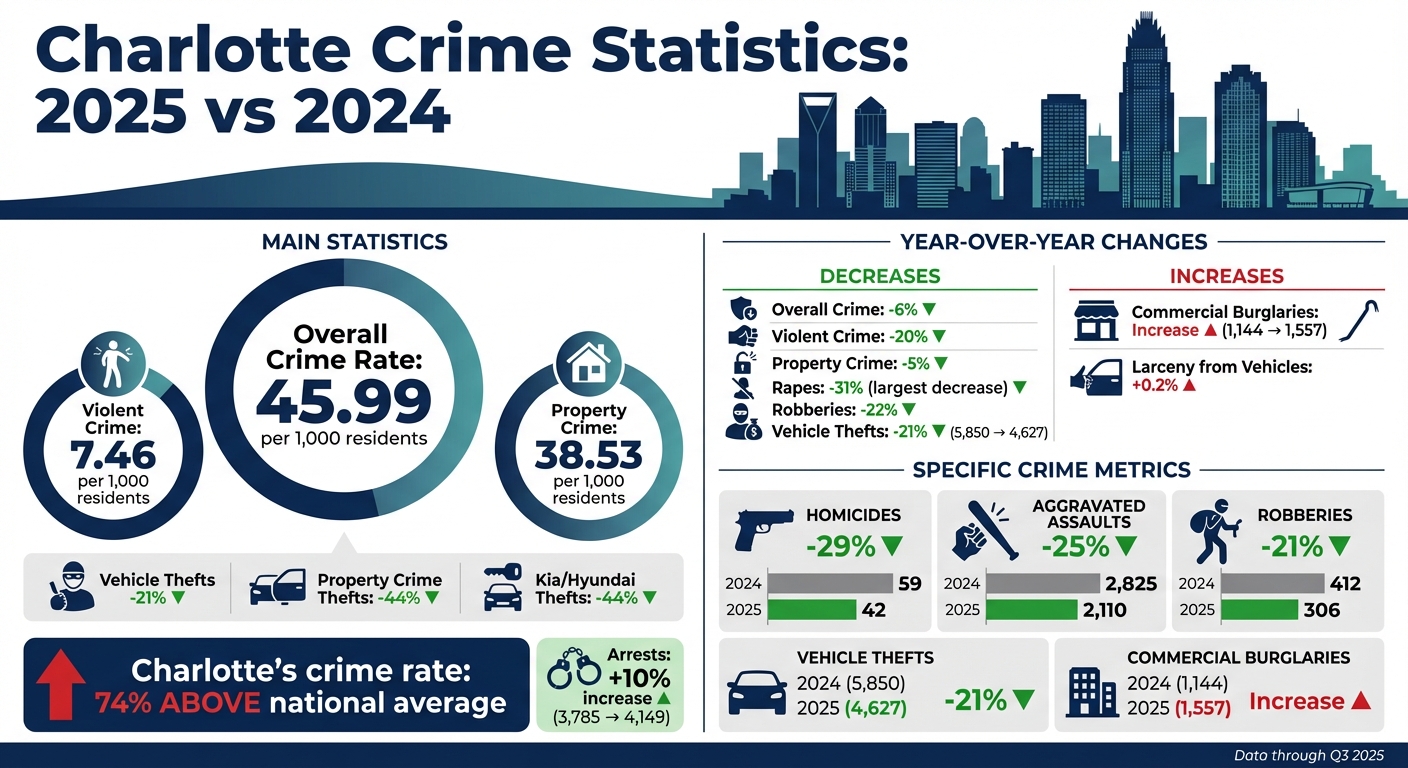
Charlotte's crime statistics for 2025 highlight progress in several significant areas. By the end of the third quarter, violent crime had dropped by 20%, while property crime saw a 5% reduction compared to the same period in 2024. These early figures suggest an encouraging overall decline in crime for the year.
Currently, the total crime rate in Charlotte stands at 45.99 incidents per 1,000 residents. This includes 7.46 violent crimes and 38.53 property crimes per 1,000 residents. While these numbers show improvement, they also reflect the ongoing challenges the city faces in ensuring public safety.
Major Crime Changes in 2025
Several key crime categories saw significant declines in 2025, painting an evolving picture of safety in Charlotte. The most substantial drop occurred in reported rapes, which decreased by 31% - the largest reduction among all crime categories. Robberies also fell by 22% through the third quarter. Vehicle thefts experienced a 21% decline in the first quarter alone, dropping from 5,850 incidents in 2024 to 4,627 by Q3 2025. Notably, thefts involving Kia and Hyundai vehicles plummeted by 44% during the first quarter.
Violent crimes, including homicides, aggravated assaults, and robberies, showed an overall decrease compared to 2024. This improvement coincided with a 10% increase in arrests during the first quarter of 2025, rising from 3,785 to 4,149 compared to the same period in the previous year. However, not all trends were positive - commercial burglaries bucked the downward trend, showing an increase even as other property crimes declined.
The table below provides a clear comparison of these changes between 2024 and 2025.
2025 vs. 2024 Crime Data Comparison
| Crime Category | Change Through Q3 2025 | Key Details |
|---|---|---|
| Overall Crime | -6% | Citywide decrease in Q1 2025 vs. Q1 2024 |
| Violent Crime | -20% | Significant improvement through Q3 |
| Property Crime | -5% | Modest decline through Q3 |
| Rapes | -31% | Largest decrease among all categories |
| Robberies | -22% | Notable drop through Q3 |
| Vehicle Thefts | -21% | From 5,850 (2024) to 4,627 (Q3 2025) |
| Kia/Hyundai Thefts | -44% | Dramatic reduction in Q1 2025 |
| Commercial Burglaries | Increase | Only major category showing growth |
Charlotte's High-Crime Areas
Knowing where crime is more prevalent in Charlotte can guide you in making informed choices about where to live, work, or spend your time. The city’s higher-crime zones are largely concentrated in West Charlotte, just north of Uptown, and along major thoroughfares. In some neighborhoods, crime rates are a staggering 250% to nearly 500% above the city average. This breakdown complements the broader 2025 crime data by highlighting areas where extra caution is warranted.
Uptown Charlotte
As Charlotte's commercial and entertainment hub, Uptown faces distinct safety challenges. Violent crime in this area is reported at 28.7 incidents per 100,000 residents, while property crime reaches an alarming 3,124 incidents per 100,000. Vehicle thefts have also seen a sharp 20% increase recently.
The nightlife and entertainment scene often lead to weekend spikes in car break-ins. Crowded spaces attract pickpockets and purse snatchers, who often target distracted visitors. While the CATS light rail is generally safe during the day, its reliability declines after midnight. If you’re parking in Uptown, valet parking is usually a safer option than street parking, and keeping valuables out of sight is a must. Let’s take a closer look at other neighborhoods where property crime rates are also notably high.
Neighborhoods with High Property Crime
Outside of Uptown, several other neighborhoods face significant property crime issues.
- West Boulevard struggles with gang activity and drug-related crimes.
- Beatties Ford Road experiences challenges tied to economic hardship.
- Hidden Valley has long dealt with higher crime rates due to its relative isolation.
- Sugar Creek sees elevated crime, particularly around its apartment complexes and light rail stations.
- Grier Heights continues to face safety concerns rooted in historic inequities.
Adding to these concerns, commercial burglaries have risen sharply, increasing from 1,144 incidents in the first half of 2024 to 1,557 in the same period of 2025.
Understanding these patterns can help residents and visitors alike take precautions and stay vigilant in areas with heightened risks.
Charlotte's Safest Neighborhoods
While some areas in Charlotte face higher crime rates, the city is also home to neighborhoods known for their safety and excellent quality of life. In fact, some neighborhoods boast crime rates up to 86% lower than the city average. These safer areas often share key traits like master-planned designs, active neighborhood associations, and even private security patrols. Let’s take a closer look at some of Charlotte’s most secure neighborhoods.
Myers Park and SouthPark
Myers Park stands out as one of Charlotte's safest neighborhoods, with crime rates significantly below the city average. This area is especially appealing to professionals with annual incomes of $50,000 or more. Its safety is bolstered by a strong sense of community and active neighborhood vigilance.
SouthPark combines security with convenience, making it a popular choice for families, young professionals, and retirees. The neighborhood features excellent schools, a robust job market, and a variety of upscale amenities, including fine dining and luxury shopping. Well-lit streets, a bustling commercial hub, and an engaged community contribute to its low crime rates.
Ballantyne
Ballantyne is another standout for safety in Charlotte, particularly favored by families and young professionals in 2025. This master-planned community is known for its organized development, well-maintained properties, and a family-friendly environment, all of which help deter criminal activity.
sbb-itb-6d427fc
What's Driving Charlotte's Crime Trends
Charlotte's crime trends in 2025 are shaped by a mix of demographic factors, policing strategies, and community initiatives. Understanding these elements sheds light on why certain areas face higher crime rates and what steps are being taken to improve safety. This knowledge is key for making informed, data-driven decisions about public safety in the city.
Demographics are a key factor in Charlotte's crime patterns. Young males, for example, are significantly more likely to be involved in violent and property crimes. In 2024, males accounted for 1,075 robbery arrests compared to just 188 females, and for 3,926 burglary arrests versus 1,005 females. Additionally, transient populations, particularly in West Charlotte's motel clusters, contribute to concentrated criminal activity, including assault, robbery, prostitution, and gang-related incidents. These demographic realities play a major role in shaping crime trends and influencing public perceptions and policy decisions across the city.
Police strategies have also played a critical role in reducing crime. The Charlotte-Mecklenburg Police Department (CMPD) reported an 8% overall drop in crime during the first half of 2025 compared to the same period in 2024. This reduction is attributed to innovative policing techniques, stronger community partnerships, and increased officer presence in high-crime neighborhoods. Programs like the Juvenile Accountability and Diversion Empowerment (JADE) team, the Coordinated Overlap Response Effort (CORE 13), and Connect Charlotte focus on specific crime types through targeted interventions. Additionally, the department has implemented civilian programs to handle lower-priority calls, allowing officers to focus on more critical issues.
Investments in workforce development and advancements in technology have also made a difference, contributing to a 25% drop in violent crime during the first half of 2025. Efforts to address repeat offenders, coupled with increased resident involvement in neighborhood safety initiatives, have led to tangible reductions in both violent and property crimes throughout Charlotte.
How to Stay Safe in Charlotte
Staying safe in Charlotte means staying informed, securing your home and vehicle, and being mindful of your surroundings. Property crimes, like larceny from vehicles, continue to be an issue, so taking proactive steps is key.
Start with securing your home. A solid home security system can make a big difference. Look for systems with cameras, motion detectors, smart locks, and timed lighting. Reinforce entry points with solid-core doors and heavy-duty deadbolts. Motion-sensor lights around doors and windows can also discourage potential intruders. Timed smart lighting can give the impression someone’s home, even when you’re not.
Be cautious with your vehicle. Car-related theft is still a concern in Charlotte. While vehicle thefts dropped by 22% in the first half of 2025, larceny from vehicles went up slightly by 0.2% during the first three quarters. Always lock your car, even if you’re stepping away for just a moment, and keep valuables out of sight to avoid tempting thieves.
Stay aware when you're out and about. When walking around, especially in entertainment hubs like Uptown, keep your phone in your pocket and your eyes on your surroundings. Stick to well-lit areas and, if possible, walk with a companion. Pickpocketing can happen in crowded spots, so keep your belongings secure. If you ever feel like a car is following you, don’t drive straight home. Instead, head to a public, well-lit area or the nearest police station.
Keep yourself informed. Staying updated on local crime trends is easier than ever. The Charlotte-Mecklenburg Police Department shares official crime stats and updates on their website (charlottenc.gov/cmpd). You can also join community programs like CMPD CHATS to collaborate with officers and neighbors on safety efforts. For real-time alerts, check out platforms like Nextdoor or neighborhood Facebook groups. Websites like CrimeGrade.org and NeighborhoodScout are also great for detailed crime data by area.
Using AdensZip for Charlotte Crime Data

When it comes to staying informed about crime in Charlotte, AdensZip steps in as a practical, AI-powered tool. It simplifies the process of accessing crime data by pulling everything into one place - no need to sift through various websites or police reports. With clear visuals and actionable insights, AdensZip provides a consolidated view that helps you make informed decisions about safety and even relocation.
How AdensZip Keeps You Informed
AdensZip gathers crime statistics, trends, and neighborhood-specific data to provide detailed reports for any ZIP code in Charlotte. Its Crime Intelligence feature offers a deep dive into specific areas, showing not just current crime rates but also how they've shifted over time. You’ll gain insight into the most common types of crimes in a neighborhood, whether safety is improving or declining, and how one area stacks up against others.
The platform also includes a Livability Score, which goes beyond just crime data. It factors in cost of living, climate, and local amenities, giving you a broader perspective on what life in a particular neighborhood might look like. This means you’re not just seeing safety stats - you’re understanding how they fit into the overall quality of life.
Why AdensZip Simplifies Moving Decisions
Deciding on a new neighborhood in Charlotte can be overwhelming, but AdensZip makes it easier by prioritizing safety information. Whether you're considering areas like Myers Park, Uptown, or Ballantyne, the platform provides up-to-date data on what’s happening in each neighborhood. Its AI-generated summaries combine safety details with real estate trends, job opportunities, and local amenities, giving you a well-rounded view of potential new homes.
AdensZip offers a free Basic plan, ideal for checking out crime data and livability scores for a single location. For those who want to dig deeper, the Premium plan costs $9.99 per month and provides comprehensive analysis across multiple neighborhoods. This lets you compare areas side-by-side, taking the guesswork out of finding the perfect spot in Charlotte.
Conclusion
Charlotte's safety in 2025 has made noticeable strides, backed by compelling data. Early 2025 statistics reveal a 29% drop in homicides (from 59 to 42), a 25% decrease in aggravated assaults (from 2,825 to 2,110), and a 21% reduction in robberies (from 412 to 306). While these numbers highlight progress, Charlotte's crime rate still exceeds the national average - an issue common in many large urban areas.
Neighborhood safety remains a key focus. Communities like Myers Park, Ballantyne, and Dilworth continue to experience low crime rates, offering peace of mind to residents. On the other hand, areas such as West Boulevard, Beatties Ford Road, and Sugar Creek demand heightened awareness. These trends align with past data, emphasizing the importance of staying informed through up-to-date crime statistics when making decisions about where to live or visit.
Whether you're moving to Charlotte, planning a trip, or already call the city home, relying on current data is essential. Crime patterns shift, and neighborhoods change - what was true a year ago might not apply today. Using tools that provide real-time crime statistics, insights into neighborhood trends, and overall livability factors can help you make well-informed choices beyond surface impressions or outdated narratives.
FAQs
How can residents stay safe in Charlotte's higher-crime areas?
Staying safe in areas with higher crime rates starts with being mindful of your surroundings. Avoid walking alone after dark, and always secure your belongings. Make sure to lock your car and home doors, and think about adding a security system or cameras for extra peace of mind. Getting involved in neighborhood watch programs and quickly reporting suspicious activity to local authorities can also contribute to a safer community.
How does AdensZip help users evaluate the safety and livability of neighborhoods in Charlotte?
AdensZip offers users access to real-time crime data, interactive maps highlighting high-risk areas, and safety ratings for neighborhoods throughout Charlotte. This makes it simple to pinpoint safer zones and identify areas that might require extra caution.
By providing insights like crime trends and practical safety advice, AdensZip helps users make informed decisions about where to live, work, or spend time in Charlotte, giving them greater confidence and peace of mind.
What causes crime rates to vary across different neighborhoods in Charlotte?
Crime rates across Charlotte's neighborhoods differ for a variety of reasons. Factors like income levels, access to essential resources, and the degree of community involvement all play a part. Other influences include the visibility of law enforcement and the presence of amenities such as schools, parks, and local businesses.
Neighborhoods that benefit from active community connections, effective policing, and well-maintained resources tend to report fewer crimes. In contrast, areas struggling with economic hardships or weaker community networks are more likely to encounter higher crime rates.